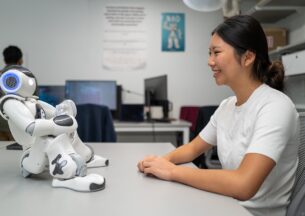

Community Data Fellow Stephania Tello Zamudio helps broaden internet access for Illinois residents
After an intensive winter of data pipeline building, running analyses, and team consultations, the winter cohort of DSI Community Data Fellows gathered to present their collaborative research with various non-profits and social impact organizations. For graduate student Stephania Tello Zamudio (MSCAPP ‘24), this wasn’t a new experience.
“Last quarter I was working with the Internet Equity Initiative and directly with Alexis Schrubbe, the director of the Initiative,” said Zamudio. “We were working on a project looking at Internet access in public libraries.” This work led naturally into the following quarter.

Zamudio spent the winter quarter focused on a new project: cleaning and organizing a ‘challenge test’ collected through the BEAD Challenge with DSI’s Internet Equity Initiative (IEI). As part of a broader infrastructure investment, Illinois is slated to receive $1 billion in federal funding dedicated to enhancing the state’s internet infrastructure under the Broadband Equity Access and Deployment (BEAD) Program. IEI was asked to build the tool used for tracking internet infrastructure, with the goal of highlighting regions lacking adequate broadband internet service. This would help ensure funding goes towards communities with the most need.
This tool allowed users to test the speed of their internet connection, both downloading and uploading speeds, and the user could then share the recorded results with IEI to collate for the state broadband office. Zamudio stepped in after the initial data collection and was focused on turning those responses into actionable datasets.
Over the course of the eight weeks, Zamudio created a process for matching speed test results with the geospatial data of the tests and helped match the results to specific internet service providers (ISPs), allowing for the data collected by IEI to be submitted to the federal government for inclusion in their broadband mapping project.
In particular, she identified community anchor institutions, an important class of broadband serviceable locations that were left off of the Federal Communication Commission (FCC)’s Broadband Map. This work resulted in a list of places to engage, including a specific request from the state library of Illinois: to direct libraries to participate in the BEAD challenge process.
Using the DSI BEAD challenge, users like local libraries could test their internet connection speeds with the simple click of a button. The user then had the option to submit these results, along with information about their geographic location and ISP, to IEI for analysis and reporting back to the state broadband office.
By getting people from across the state to participate in the BEAD challenge, Illinois can focus funds on communities that aren’t adequately served by their ISPs. During the 60-day window of the speed challenge process, over 12,000 speed tests were captured from across the state.
Community Data Fellows: data science with impact
Zamudio first heard about the Community Data Fellows (CDF) through a friend in her program. “I heard about CDF through a friend that participated in the first quarter. He mentioned the fact that he was working directly with organizations around the area and doing real work for them,” said Zamudio. “That was one of the reasons I’m getting this degree, because of my interest in this intersection between data science and the public good.”
 She first started working during the 2023 fall quarter on a project with Santiago Segovia (MSCAPP ‘24) involving approximating internet access using FCC and Census Bureau data. That work naturally led to the following quarter’s project and the focus on taking data from the BEAD challenge to rectify any errors in the state broadband map.
Community Data Fellows is a program that pairs local, community-based nonprofit organizations with UChicago graduate students who want to further develop their skills in technology and policy analysis. Zamudio said that working on the project “amplified [her] belief that data science can be a very important tool to improve the lives of communities. The BEAD Challenge project, in particular, served as a bridge between the citizens of Illinois and the government by facilitating access to the public funding they needed.”
Reflecting on Zamudio’s experience
The IEI’s BEAD challenge offered Zamudio a unique opportunity to work across multi-institutional teams. Understanding data as the shared product, and which institutions provide the data sources, as well as the requirements for that data, offered an interesting perspective that she hadn’t previously experienced.
“Steph rose to the occasion to hone new skills in a short period of time in order to see the unseen,” said Alexis Schrubbe, Director of the Internet Equity Initiative. “By doing so, she helped a team of dedicated researchers direct much-needed funding to technologically underserved areas in Illinois during this once-in-a-generation investment in infrastructure.”
Zamudio looks forward to seeing her work improve the internet access of people most in need, based on the BEAD challenge speed test. And while her work on the project has ended with the conclusion of the winter quarter, the skills she developed through working with IEI will carry on.
Zamudio had lots of praise of the community data fellows program, stating that it taught her how to keep code clean across multiple iterations, how to communicate with a data science team, and how to work more collaboratively using Github. It also inspired Zamudio to take a web mapping class.
“My first year in grad school, they taught us how to code,” Zamudio said. “But it isn’t until you start building practical experience that you realize how important it is to learn how to read other people’s code.”
This story was originally published by the Data Science Institute.