Two UChicago CS Students Awarded NSF Graduate Research Fellowship
Dale Decatur, a second-year PhD student working with Assistant Professor Rana Hanocka, and Stanley Wu, a first-year PhD student jointly advised by Neubauer Professor Ben Zhao and Neubauer Professor Heather Zheng, were among nine students from the University of Chicago Physical Sciences Division to receive the NSF Graduate Research Fellowship (GRFP). The program provides funding support for exceptional students pursuing master’s or doctoral degrees in STEM disciplines. The five-year fellowship provides three years of financial support that includes an annual stipend of $37,000.
Dale Decatur
 Decatur is interested in creating automated techniques to allow users to generate and manipulate visual content. Although the processing and comprehension of visual input is seemingly trivial for humans, it is a longstanding and difficult challenge in artificial intelligence and Decatur hopes to take steps towards solving it through his work.
“Given the importance and challenges associated with understanding and interacting with visual mediums, I am incredibly interested in studying the field of computer vision,” Decatur states. “I also find it satisfying that my work has a visual output. Not only do I get to look at cool images all day, but I can also share these visual components of my research with others.”
Since current tools for manipulating 3D content require extensive training and experience, Decatur hopes to bridge that gap by making 3D content creation accessible to everyone, regardless of their technical expertise. He aims to democratize the 3D modeling process by building tools that use intuitive guidance mediums.
Previously, he has already published papers on technology such as the 3D Highlighter and 3D Paintbrush, which use text to localize and apply local edits to specific regions on a 3D object. His proposal builds on these existing ideas as Decatur looks to extend these techniques to use other guidance mediums beyond text. He hopes to build tools that can manipulate 3D shapes using just images or even other 3D objects to describe the desired edit.
“An NSF Fellowship means a lot to me. I am incredibly honored to have been selected and thankful for the support I have received from mentors, collaborators, friends and family throughout this process,” Decatur stated. “This fellowship will allow me to pursue the unique intersection between images and 3D graphics and in the process I hope to make lasting contributions in how we use machines to understand and interact with the visual world.”
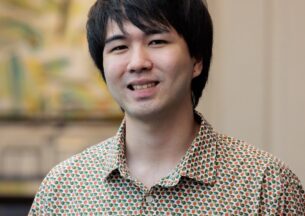
Stanley Wu
 Wu is interested in building systems and tools that protect people from malicious use of generative AI. As an undergrad, he was eager to work in the field of machine learning. However, as he began to dive deeper into the topic, he realized that machine learning came with many privacy and security issues that he wanted to address.
“As I gained more experience working in privacy and security, I realized that there are many points of failures in machine learning that have not yet been adequately explored,” Wu stated. “I believe this is crucial to research while generative AI is still in its infancy.”
For his research project, Wu sought to address malicious intents of generative AI, which continues to be an issue despite calls for better copyright and privacy protections to prevent intellectual property from unauthorized use. SAND lab, which Wu is a part of, already developed Glaze, a tool that protects individual artists by adding barely visible cloaks to images that cause models trained on them to learn the wrong style. Even though animators and video creators are unable to use Glaze, their work needs equal protection to prevent unauthorized use from AI. Wu seeks to address these issues by building on Glaze’s existing cloaking algorithms and apply it not just to images, but also video domains.
Zhao believes Wu was the perfect candidate for this fellowship.
“Heather and I have been really fortunate to have several truly exceptional PhD students working with us in the SAND lab. In many ways, Stanley exemplifies our entire group by combining a strong technical skill set, a keen awareness of real world impacts of cutting edge research, and a strong ethical compass to focus on projects that bring a net good to society. We’re thrilled for him to receive this recognition.”
Wu hopes that his work would have a large and tangible impact. He is hopeful that the NSF fellowship will help support him and the SAND lab to continue pursuing projects that investigate generative AI’s impact on individuals, and on creating solutions that protect people from being exploited by generative AI models.