
Jakub Limanowski (TU Dresden) - Precision Control as a Key Mechanism of Flexible Body Representation
Synopsis: Many neuroscientists, psychologists, and philosophers believe that embodied selfhood, the experience of having a body and being in control of its actions, relies on some representation of the ‘own’ body in the brain. But maintaining an adaptive neuronal body representation is not easy: It has to be stable enough for self-identification and action planning, but it also has to be flexible enough to adapt to a constantly changing environment—and a constantly changing body. Recent work appealing to probabilistic Bayesian inference, particularly the predictive coding framework, has opened up a new perspective on the potential neurocognitive mechanisms underlying body representation. A key tenet of these proposals is that body representation in the brain can be described in terms of a hierarchical generative model, which infers the causes of (bodily) sensations; and which is itself constantly updated based on integrating information from all relevant sensory modalities. In this talk, I shall focus on one particular key mechanism within such models; namely, top-down precision control as means to contextualise incoming sensations. I shall link this to (my) recent work; which suggests that precision control could explain the contextual flexibility of visuo-proprioceptive body representation. I shall conclude how such a mechanistic view may deepen our understanding of embodied selfhood, and how it may help to tackle challenges to embodied selves that arise through technological developments such as cyber-physical interactions.
More info on Jakub’s work and methods: Our research focus is on the cognitive-computational basis of human perception and action, with an emphasis on the mechanisms of how body models are constructed and updated (in particular, in virtual environments and during human-machine-interactions). We use virtual reality together with state-of-the-art sensors (e.g., data gloves) and interventions (TMS, pharmacology) for experimental manipulation, and look at how these manipulations affect behaviour, brain activity (using fMRI and M/EEG), and subjective experience together. We use computational modelling to gain a mechanistic understanding of these data.
To attend via Zoom, see information at the UChicago HCI Club website.
Speakers

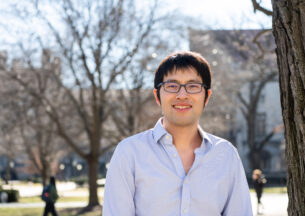
Jakub Limanowski
I am a Freigeist Fellow and head of the Human Perception and Action Lab at the Centre for Tactile Internet of the TU Dresden.
Our research focus is on the cognitive-computational basis of human perception and action, with an emphasis on the mechanisms of how body models are constructed and updated (in particular, in virtual environments and during human-machine-interactions). We use virtual reality together with state-of-the-art sensors (e.g., data gloves) and interventions (TMS, pharmacology) for experimental manipulation, and look at how these manipulations affect behaviour, brain activity (using fMRI and M/EEG), and subjective experience together. We use computational modelling to gain a mechanistic understanding of these data.